
Data Governance by Design
Governance Is Not an Afterthought
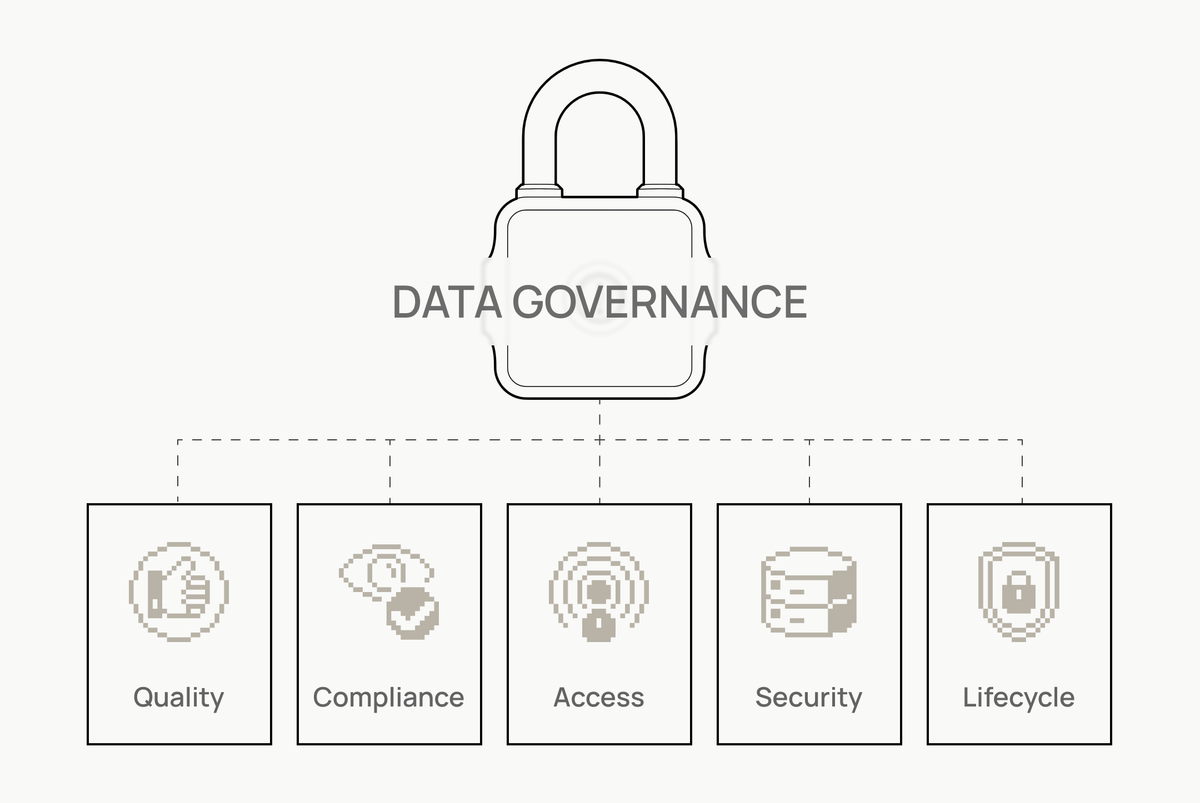
In regulated environments, governance is not something you “add” once software is already in motion. The moment controls become retrofitted, they turn into operational debt: duplicated processes, inconsistent policies, and blind spots that appear precisely where guarantees should have existed from day one. Governance by design avoids this spiral by treating trust principles (confidentiality, integrity and traceability) as core architectural constraints. Instead of being external requirements, they shape how data moves, how systems communicate, and how responsibilities are defined.
Encryption Beyond Storage
Encryption is often reduced to a storage feature, but real governance demands continuity. Data should remain cryptographically accounted for throughout its entire lifecycle: in transit, in memory, during transformations, and across service boundaries.
That continuity depends on treating encryption as an evolving context rather than a static configuration. Per-tenant key rotation prevents long-lived secrets from becoming systemic risks. Hardware-backed roots of trust ensure that keys originate from environments that cannot be forged in software. Cryptographic proofs tied to API operations allow systems to validate the authenticity of what they receive rather than trusting the infrastructure around them.
When encryption becomes contextual, every transformation is implicitly verifiable. Instead of retroactively asserting that data was handled correctly, the system carries the proof with it.
The Trifecta of Trust: Logging, Access, Transparency
Logs are only useful when they describe intent and consequence with clarity. Modern governance architectures distinguish between audit, operational and debug streams because each serves a fundamentally different purpose. Audit logs form an immutable timeline of accountability. Operational logs describe system behaviour without revealing sensitive content. Debug logs support development but are intentionally ephemeral to avoid leaking unnecessary detail.
Access control reinforces this structure. Role-based models enforce separation of duties, while contextual MFA ties authentication to the risk profile of each action. Together they provide traceability without degrading usability. Systems can prove that an action occurred, under the right identity and conditions, without revealing confidential data in the process.
Conclusion
Data governance by design is not about passing audits; it’s about constructing systems that produce their own evidence of correctness. Compliance becomes a natural byproduct of architecture rather than a burden imposed on top of it. When confidentiality, integrity and traceability shape the foundations of a platform, trust stops being an external requirement and becomes an inherent property of the system itself.